











Blog
PCB Mount vs Panel Mount Fuse Holders: Complete Engineering Comparison

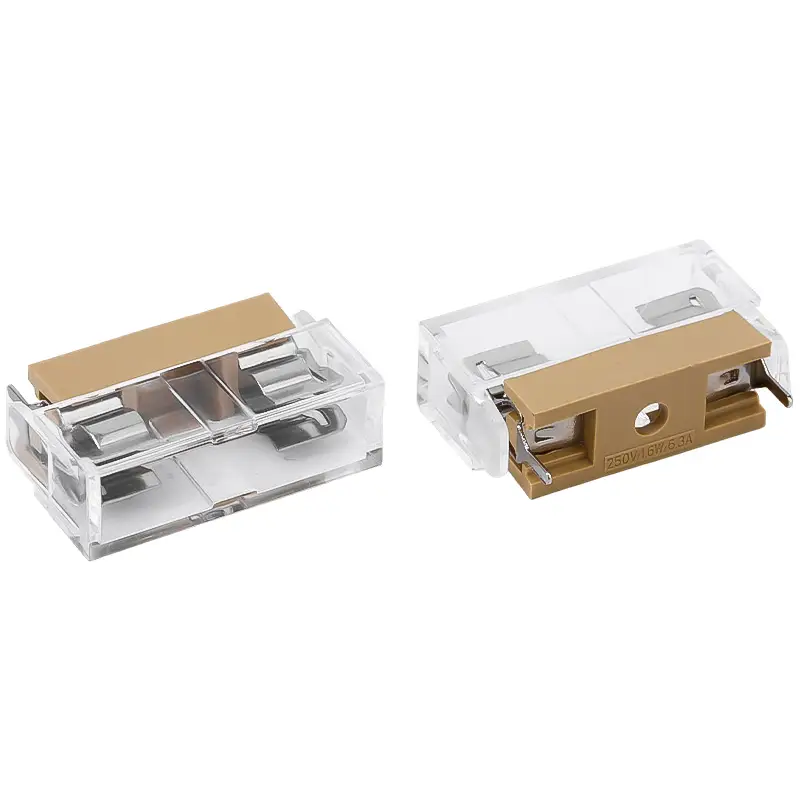
When designing circuit protection for electronic equipment, choosing the correct fuse holder mounting style is as critical as selecting the fuse itself. The two most common configurations — PCB mount fuse holders and panel mount fuse holders — serve the same core function but differ dramatically in assembly method, serviceability, vibration resistance and cost structure.
For engineering teams working on automotive, industrial, energy storage or power supply projects, understanding these differences helps optimize board layout, reduce assembly cost and improve long-term field reliability. This guide breaks down the key technical and practical comparisons between the two styles, based on GFEFUSE’s full line of UL94-V0 rated fuse holders.
Core Definition & Basic Construction
PCB Mount Fuse Holders
PCB mount fuse holders are designed to be soldered directly onto a printed circuit board, either through-hole (THT) or surface-mount (SMT) technology. They integrate the fuse socket into the board itself, eliminating external wiring between the fuse and the circuit.
GFEFUSE PCB mount models range from 5×20mm tubular sockets to horizontal automotive blade fuse holders (such as the GF-702 series and R3-67B), supporting current ratings from 10A up to 50A and voltages up to 1000V DC.
Panel Mount Fuse Holders
Panel mount (also called chassis mount) fuse holders are installed through a cutout in an equipment enclosure, front panel or chassis wall. They are secured by a threaded nut or mounting flanges, with terminals on the rear side for wire or bus bar connection.
Typical GFEFUSE panel mount models include the R3(11B) 5×20mm Bakelite holder and R3-67A 6.35×31.75mm base mount holder, widely used in instrument front panels, power supply enclosures and solar combiner boxes.
Side-by-Side Technical Comparison
| Parameter | PCB Mount Fuse Holder | Panel Mount Fuse Holder |
|---|---|---|
| Mounting Method | Through-hole or SMT soldering to PCB | Threaded nut / flange fixed to chassis / panel |
| Typical Current Range | 1A – 50A | 10A – 100A+ |
| Typical Voltage Range | Up to 1000V DC | Up to 1500V DC |
| Assembly Process | Automated SMT/THT soldering | Manual or semi-manual assembly |
| Field Replaceability | Requires PCB access; not front-serviceable | Front-panel access; tool-free or simple tool replacement |
| Vibration Resistance | Excellent (direct solder connection) | Good (depends on terminal crimp quality) |
| Space Usage | Occupies PCB board area | Occupies panel / enclosure space |
| High-Volume Cost | Lower (automated assembly, no extra wiring) | Higher (manual labor, harness cost) |
| Sealing Option | Limited | IP rated versions available for harsh environments |
Key Selection Criteria for Engineers
1. Production Volume & Assembly Cost
For high-volume production (10k+ units per batch), PCB mount fuse holders almost always deliver lower total cost. Automated wave or reflow soldering eliminates manual labor, reduces wiring errors and improves consistency across every unit.
For low-volume builds, custom enclosures or aftermarket equipment, panel mount holders often have lower per-unit tooling cost and require no PCB redesign to integrate.
2. Field Serviceability
If the end equipment requires regular fuse replacement, maintenance or on-site troubleshooting, panel mount is the preferred choice. Front-panel access allows technicians to replace fuses without opening the enclosure or touching internal circuitry, reducing downtime and electrical safety risk.
PCB mount holders are better suited for sealed units, long-life equipment or applications where fuse replacement is rare and performed only by trained service personnel.
3. Environmental & Mechanical Conditions
- High vibration environments (automotive, off-road, heavy machinery): PCB mount holders offer superior mechanical stability because the fuse is rigidly soldered to the board. GFEFUSE automotive blade holders use 0.3–0.5mm thick brass clips to maintain consistent clamping force under continuous vibration cycles.
- Dust / moisture / outdoor environments: Panel mount holders can be specified with IP-rated seals, making them more suitable for outdoor solar combiner boxes, industrial cabinets and marine equipment.
4. Electrical Performance
For low-voltage signal and control circuits, both styles perform similarly. For high-voltage DC (above 500V) and high-current (above 30A) applications:
- Panel mount holders often have larger terminal surfaces and better heat dissipation, supporting higher continuous current ratings.
- PCB mount holders require careful PCB trace width design to avoid overheating and voltage drop at high current levels.
Typical Application Scenarios
Best for PCB Mount Fuse Holders
- Automotive ECU and on-board control boards
- Consumer electronics and internal power supplies
- Industrial control PCB assemblies
- High-volume mass-produced equipment
- Space-constrained board-level designs
Best for Panel Mount Fuse Holders
- Instrument and meter front panels
- Solar PV combiner boxes
- Battery energy storage (BESS) cabinet enclosures
- Industrial power distribution units
- Aftermarket spare parts and service kits
Practical Design Checklist
Before finalizing your BOM, verify these points:
- Confirm the holder matches your fuse size, current and voltage rating.
- For PCB mount: follow the manufacturer’s recommended PCB footprint and minimum trace width for the rated current.
- For panel mount: verify panel cutout dimensions and thread size match your enclosure design.
- Check housing material rating: prioritize UL94-V0 flame retardant (PBT, Bakelite) for all industrial and automotive applications.
- Evaluate contact material: brass or phosphor bronze with tin or tin-nickel plating for reliable long-term performance.
Final Thoughts
Neither mounting style is universally superior. PCB mount fuse holders excel in high-volume, board-integrated designs where automation and vibration resistance are priorities. Panel mount fuse holders are the practical choice for front-panel access, field serviceability and high-power enclosure applications.
GFEFUSE offers both mounting styles across our full tubular and blade fuse holder range, all with UL94-V0 housings and RoHS compliance. For help selecting the optimal model for your project, download our datasheets or contact our engineering team for application support.