











Blog
5 Common Fuse Holder Selection Mistakes and How to Avoid Them

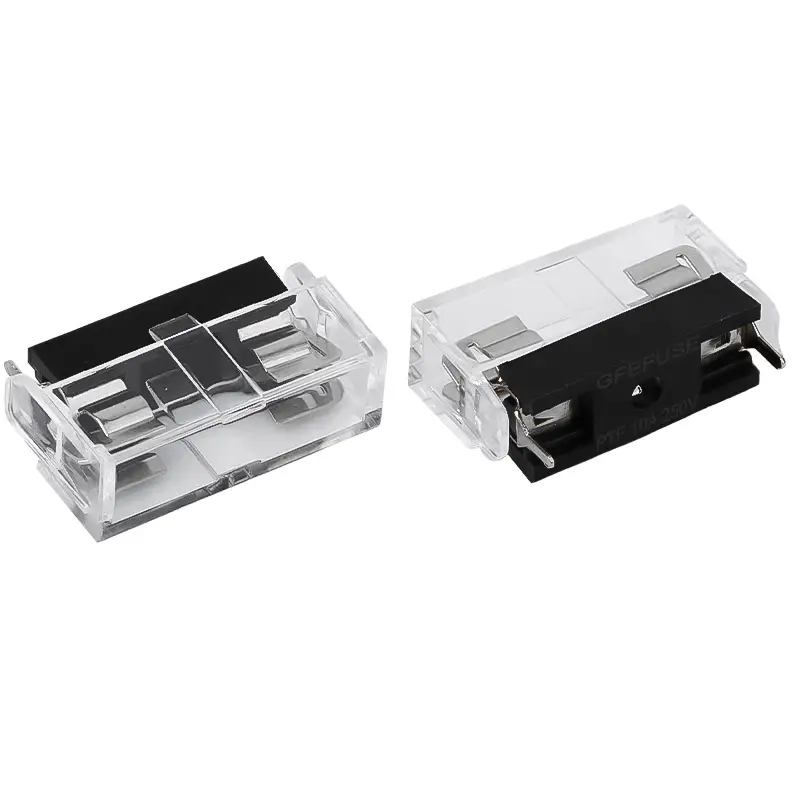
Selecting the wrong fuse holder is one of the most overlooked causes of circuit protection failure. Many engineers focus only on fuse size and current rating, ignoring critical factors that lead to overheating, poor contact, premature failure and even safety hazards in the field.
Based on GFEFUSE’s years of application support for automotive, industrial and energy storage projects, this article breaks down the 5 most common fuse holder selection mistakes and provides actionable engineering fixes.
1: Only Matching Fuse Size, Ignoring Current Derating
The problem: Many designers choose a fuse holder based solely on matching the fuse’s physical size and nominal current rating, without applying environmental derating.
Why it fails: A fuse holder’s rated current is defined at room temperature (typically 25°C). In enclosed housings, high-ambient environments or high-vibration conditions, effective current carrying capacity drops significantly. Without derating, the holder overheats, contact resistance rises, and the fuse may nuisance trip or fail to break at fault current.
Correct practice:
- Apply a minimum 125% derating factor for normal indoor environments.
- Increase to 150% derating for ambient temperatures above 50°C or sealed enclosures.
- For example: a 20A circuit requires a holder rated for at least 25A continuous.
- GFEFUSE PCB mount fuse holders are rated from 10A to 50A with clear derating curves in every datasheet.
2: Choosing the Wrong Mounting Style for the Environment
The problem: Selecting PCB mount fuse holders for equipment that requires regular field maintenance, or panel mount holders for high-vibration on-board applications.
Why it fails:
- PCB mount holders require opening the enclosure and board access to replace fuses, increasing service downtime in field-deployed equipment.
- Panel mount holders installed on vibration-heavy machinery can develop loose terminal connections over time, leading to arcing and heat buildup.
Correct practice:
- Use PCB mount fuse holders for sealed units, high-volume automated production and vibration-intensive environments like automotive ECUs.
- Use panel mount fuse holders for front-panel access, solar combiner boxes, industrial cabinets and equipment requiring regular fuse replacement.
- For mobile and off-road equipment, specify holders with integrated locking features and high contact retention force.
3: Overlooking Housing Material and Soldering Compatibility
The problem: Specifying low-grade plastic housings without verifying flame rating or reflow compatibility, especially for surface-mount and through-hole PCB holders.
Why it fails:
- Non-flame-retardant housings pose fire risk under fault conditions.
- Materials not rated for reflow soldering will deform, blister or release gases during SMT assembly, causing dimensional drift and contact misalignment.
Correct practice:
- Require UL94-V0 flame retardant rating for all industrial and automotive applications.
- For through-hole and SMT assembly, confirm the housing material supports lead-free reflow profiles: 260°C for 3 seconds is the industry standard.
- GFEFUSE uses engineering-grade PBT and glass-filled PBT for all PCB mount models, with full soldering profile specifications published.
4: Ignoring Contact Material and Contact Resistance
The problem: Assuming all metal contacts perform the same, without checking base material, plating and maximum contact resistance.
Why it fails:
- Cheap steel or zinc-plated contacts develop oxidation and corrosion over time, increasing contact resistance.
- Higher resistance generates more heat at the contact interface, accelerating aging and causing voltage drop in sensitive circuits.
Correct practice:
- Specify brass or phosphor bronze base material with tin or tin-nickel plating.
- Look for a maximum contact resistance of ≤5mΩ to ≤50mΩ depending on current rating.
- Verify contact spring design maintains consistent clamping force through thermal cycling and vibration.
- GFEFUSE blade fuse holders use precision-formed brass clips with stable insertion/extraction force over thousands of mating cycles.
5: Matching Only Nominal Voltage, Not Dielectric Strength
The problem: Selecting a holder with a nominal voltage rating equal to the circuit voltage, without considering transient overvoltages or dielectric withstand requirements.
Why it fails:
- Nominal voltage rating only indicates normal operating voltage.
- Under fault conditions, switching transients or lightning surges, insufficient dielectric strength can cause arcing between terminals or breakdown to chassis.
Correct practice:
- The holder’s dielectric withstand voltage must be at least 2–3x the maximum operating voltage.
- For 1000V DC solar and energy storage systems, choose holders with ≥3000V AC dielectric test rating.
- Always confirm creepage and clearance distances meet your safety standard (IEC 60127, UL 248).
Quick Pre-Production Validation Checklist
Before releasing your BOM, verify these 5 points:
- Fuse holder current rating ≥ 125% of circuit operating current
- Mounting style matches serviceability and vibration requirements
- Housing material is UL94-V0 rated and soldering-compatible
- Contacts are brass/phosphor bronze with published contact resistance
- Dielectric withstand voltage meets safety standard for your voltage class
FAQs
1: Can I use a higher current fuse holder in a lower current circuit?
Yes, using a higher rated fuse holder is electrically safe and often improves reliability due to lower contact resistance and better heat dissipation. The only downsides are slightly higher cost and larger physical size.
2: How often should fuse holders be replaced?
Under normal operating conditions, quality fuse holders have a service life of 10+ years. They should be inspected if fuses repeatedly blow in the same position, or if there is any sign of discoloration, melting or corrosion at the terminals.
3: Do all fuse holders of the same size have the same rating?
No. Two holders that accept the same 5x20mm fuse can have very different current, voltage and temperature ratings. Always check the manufacturer’s datasheet, not just the physical form factor.
Final Note
Most fuse holder failures are preventable with proper upfront engineering selection. By avoiding these five common mistakes, you can significantly improve circuit reliability, reduce field service costs and extend equipment service life.
GFEFUSE offers a full range of UL94-V0 rated PCB mount, panel mount, blade and tubular fuse holders for automotive, industrial and renewable energy applications. Browse our fuse holder catalog or download individual datasheets for complete electrical and mechanical specifications.
For custom applications or design support, contact our engineering team for a personalized recommendation.