









Blog
1500Vdc aR DC Fuse Complete Selection Guide for BESS & Wind‑Energy

Introduction
Selecting the right 1500Vdc aR-class fast-acting DC fuse is critical for the safety and reliability of lithium-ion battery energy storage systems (BESS) and wind power converter DC-link circuits.
Many design engineers focus only on voltage and current ratings. However, they often overlook four key factors: L/R time constant, temperature and altitude derating, terminal mechanical construction, and I²t coordination with the BMS.
This guide consolidates practical knowledge for the GFHVT1500 series 1500Vdc square-body DC fuses. It covers circuit parameter evaluation, busbar mechanical matching, environmental derating, and system protection coordination. By following this guide, you can avoid common field failures in energy storage and wind projects.
All product links below point to existing product detail pages.
1. Understand the L/R Time Constant
The L/R time constant equals circuit inductance divided by circuit resistance, measured in milliseconds (ms). It directly determines the actual interrupting performance of DC fuses.
Important: The interrupt ratings listed on datasheets are defined under specific L/R conditions and cannot be applied universally.
1.1 Low L/R Circuit (≤5 ms)
This condition is common in standard rack-mount BESS main circuits, where fault current decays quickly.
- Recommended series: -E suffix
- Achieves 250kA @ 1500Vdc interrupt rating under L/R ≤5 ms
- Reference products: GFHVT1500-59E, GFHVT1500-74E, GFHVT1500-D105E
1.2 High L/R Circuit (≤15 ms)
This condition frequently appears in wind turbine converter DC-link circuits and long-cable BESS systems.
- Recommended series: -ES suffix
- Maintains 50kA @ 1500Vdc interrupt capability with L/R ≤15 ms
- Reference products: GFHVT1500-59ES, GFHVT1500-D105ES, GFHVT1500-S105ES
Key Tips
- Run circuit simulation to confirm the actual L/R value before fuse selection.
- Never apply the 250kA rating of the -E series directly to high-L/R wind converter circuits.
- Long internal cabinet cables increase total inductance. Always account for this factor.
2. Ambient Temperature & Altitude Derating
Fuse nominal ratings are defined under standard lab conditions:
- Ambient temperature: -5°C to +40°C
- Working altitude: ≤2000 m
- Sufficient ventilation
Sealed energy storage cabinets usually exceed these reference conditions. Therefore, you must apply derating correction.
2.1 Derating Rules
Standard conditions: Continuous current ≤ 75% of rated current
Cabinet temperature >40°C: Further reduce continuous working current
Altitude >2000 m: Extra derating required (air insulation drops, heat dissipation worsens)
Forced air cooling: Refer to the derating curve on the datasheet
2.2 Real-World Notes
- Container-type BESS installed at high altitude needs extra derating calculation beyond the 75% baseline rule.
- Fully sealed, fanless cabinets require internal temperature rise evaluation, not just site ambient temperature.
Reference compact rack-mount products: GFHVT1500-A59E, GFHVT1500-A59ES
3. Terminal Mechanical Types Comparison
Electrical parameters alone cannot guarantee reliable field performance. Improper terminal matching causes poor contact and overheating risk.
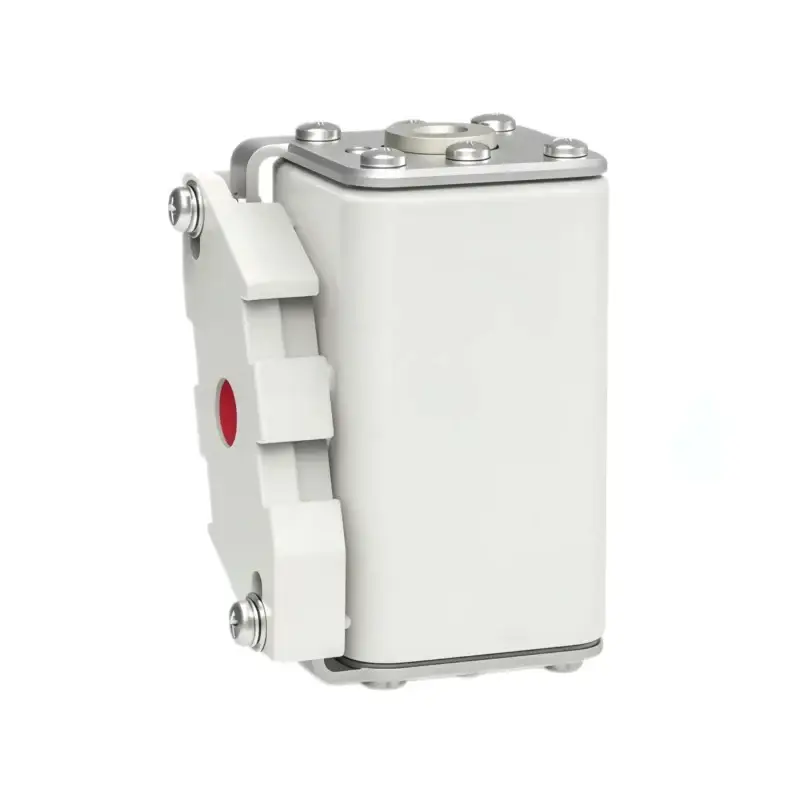
The GFHVT1500 series offers multiple terminal structures to fit different cabinet layouts:
A-Type: Flush 2×M10 flat mounting — Compact rack-mount battery modules, space-saving design
B-Type: Long bolt terminal — General cabinet copper busbar connection
U-Type: DIN fork terminal — DIN rail holder installation
K-Type: Custom vertical fork terminal — Custom cabinet mechanical layout
D-Type: 4×M10 heavy-duty terminal — 400A+ main circuit for MW-level BESS
S-Type: Compact 2-pole terminal — High-current space-limited cabinet design
Product References
- D-type heavy-duty: GFHVT1500-D105E
- S-type compact: GFHVT1500-S105ES
Installation Reminders
- Follow datasheet torque requirements for mounting holes and thread depth.
- Tighten bolts to the specified torque. Loose contact creates dangerous overheating.
- Tin-plated terminals provide anti-oxidation protection for long-term outdoor energy storage projects.
- Request CAD drawings early in the design phase to avoid mechanical interference.
4. Step-by-Step Fuse Selection Workflow
Follow this workflow for your BESS or wind converter project:
Step 1: Confirm System Parameters
Collect:
- Rated DC voltage
- Continuous working current
- Short-circuit current
- Circuit L/R time constant
Step 2: Select Terminal Style
Match the terminal type according to your busbar layout and cabinet mechanical space.
Step 3: Electrical Rating Screening
- Apply the 75% continuous current rule.
- Add temperature and altitude derating.
- Choose -E or -ES version based on L/R time constant.
High-current container BESS reference: GFHVT1500-159E
Step 4: Protection Coordination Check
Verify minimum breaking current and I²t to match the battery BMS protection curve.
Step 5: Datasheet Review & Testing
- Check TCC curve, I²t value, and derating table.
- Prototype short-circuit testing is strongly recommended before mass production.
5. I²t Coordination Between DC Fuse and BMS
I²t coordination is an essential safety design for lithium-ion energy storage systems, even when voltage and current ratings are correct.
Key Definitions:
- Melting I²t: The energy required to melt the fuse element.
- Clearing I²t: Total energy passed through the circuit until the fault is fully cleared.
The BMS hardware overcurrent protection must coordinate with the fuse clearing I²t. In other words, the fuse must operate before the battery cell suffers thermal runaway damage.
Important Points
- Do not rely only on rated voltage and current for selection. Always perform I²t coordination analysis.
- The actual circuit L/R affects clearing I²t. Use I²t data measured under your real L/R condition.
- Datasheet I²t values are tested under defined conditions. For custom high-inductance circuits, contact our engineering team for support.
Summary
Five core factors govern 1500Vdc aR DC fuse selection for BESS and wind-energy projects:
- L/R time constant — choose between -E and -ES variant.
- Temperature and altitude derating — calculate environmental correction.
- Terminal type matching — match busbar assembly mechanical requirements.
- Step-by-step rating selection — apply continuous current derating rules.
- I²t coordination — validate with battery BMS protection curve.
For fuse selection consulting, L/R evaluation, or I²t matching support, contact our engineering team for your energy storage and wind-power project.
Reference: IEC 60269 Low-Voltage Fuse Standard