









Blog
How to Choose EV, Solar PV and Bolt-Down Fuse & Fuse Holder for DC Circuit Protection | GFEFUSE

How to Choose EV, Solar PV and Bolt-Down Fuse & Fuse Holder for DC Circuit Protection
Circuit protection is the foundation of safe operation for electric vehicles, energy storage, solar PV systems and heavy-duty DC equipment. Choosing the wrong fuse or fuse holder leads to nuisance blowing, arc risks, equipment burnout and even safety accidents. Many OEM engineers, system integrators and purchasing managers struggle to distinguish between automotive blade fuses, bolt-down fuses, ANL/MIDI/MEGA high-current fuses and PV DC fuses. This guide explains core selection rules, key technical parameters and common mistakes, to help you source reliable DC fuses and fuse holders efficiently.
GFEFUSE is a professional manufacturer and supplier of DC fuses and fuse holders. We produce a full range of circuit protection products including automotive blade fuses, bolt-down fuses, ANL, MIDI, MEGA fuses, EV high-speed DC fuses, photovoltaic fuses and matching fuse bases. Our products pass UL, CE, TUV, CQC and REACH certifications, supporting standard stock supply and OEM custom service for EV, solar, energy storage, marine and industrial DC projects.
1. Core difference between AC fuse and DC fuse
Most buyers make the first mistake: using ordinary AC fuses on DC circuits. AC current crosses zero twice per cycle, which helps extinguish electric arcs easily. DC current has no natural zero-crossing point. Once a short-circuit fault occurs, the DC arc is much harder to break. Only fuses specially designed for DC application can provide the required breaking capacity.
- AC fuse: Not suitable for continuous DC fault breaking
- PV fuse: Optimized for low-fault-current reverse current protection in solar strings
- EV high-speed DC fuse: Designed for high fault current, fast breaking, anti-vibration automotive environment
- Bolt-down high-current fuse: For battery main circuit, inverter and heavy-load DC distribution
Voltage rating rule: The fuse DC rated voltage must be equal to or higher than the maximum working voltage of your circuit. Using a lower DC voltage fuse will cause failure to break the arc and explosion hazard.
2. EV high voltage DC fuse and fuse holder selection
Electric vehicles, hybrid cars and EV charging piles require automotive-grade DC fuses. EV fuses face continuous vibration, wide temperature fluctuation and high short-circuit current. General solar fuses cannot replace EV fuses.
Key parameters to check before sourcing:
- DC voltage rating: 400Vdc, 500Vdc, 750Vdc, 1000Vdc are common options
- Breaking capacity: Must meet the maximum prospective short-circuit current of the battery pack
- Time-current characteristic: Fast-acting type for battery main protection; delay type for auxiliary circuits
- Mechanical performance: Comply with ISO 16750 shock and vibration requirements
- Matching fuse holder: Heat-resistant, flame-retardant housing, stable bolt contact structure
GFEFUSE EV fuse series covers 35A–600A high current models, with supporting bolt-type fuse holders for battery management systems, on-board chargers and DC-DC converters.
3. Solar PV fuse selection for photovoltaic combiner boxes
Solar PV systems work under long-time outdoor high temperature. PV fuses are used to protect PV modules and prevent reverse current between different strings. Important notes for PV fuses:
- PV fuse is marked with PV DC rating, not general AC rating
- Temperature derating: Continuous high ambient temperature reduces the actual carrying current
- Fuse holder needs IP protection level for outdoor installation
- Do not mix EV fuses and PV fuses even if the current and voltage look the same
GFEFUSE PV fuses and fuse bases are widely used in solar combiner boxes, off-grid solar systems and small energy storage projects.
4. Bolt-down, ANL, MIDI and MEGA high-current fuse application
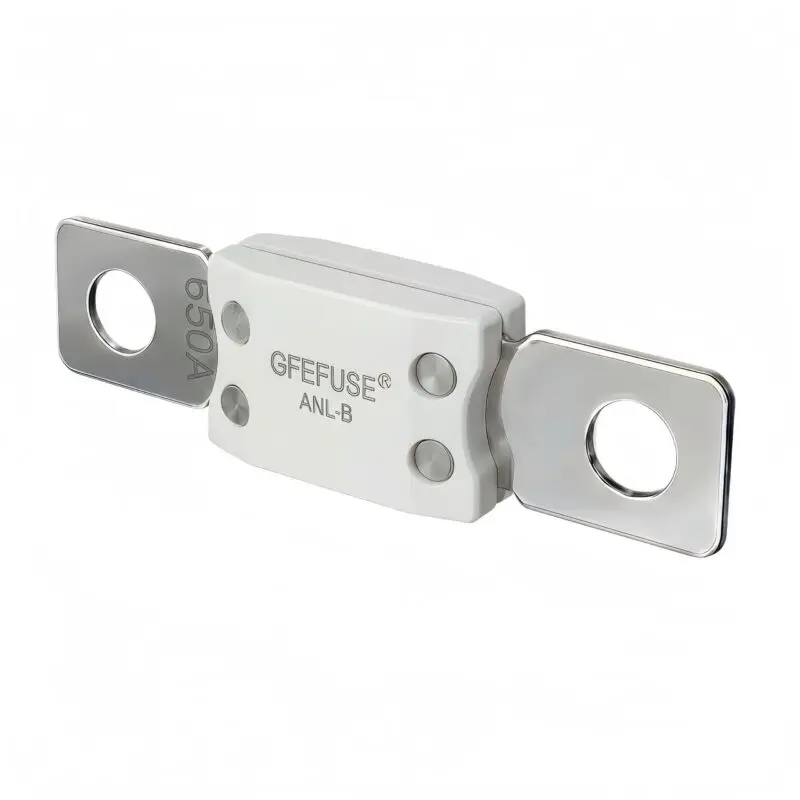
For battery banks, car audio, marine, RV and heavy-duty DC distribution, bolt-down ANL, MIDI, MEGA fuses are the mainstream. These are high-current low-voltage DC fuses with simple installation and strong overload resistance.
- ANL fuse: Common for main battery protection
- MIDI / MEGA fuse: Compact size, widely used in auxiliary distribution circuits
- Bolt-down structure: Low contact resistance, suitable for long-time heavy current
When purchasing, check the copper terminal thickness and insulation material of the fuse holder. Poor-quality holders will generate heat under continuous high current and cause hidden dangers.
5. Blade fuse for low voltage automotive circuit
Mini blade, standard blade and maxi blade fuses are still widely used in 12V/24V low-voltage automotive circuits, trucks and engineering vehicles. They are convenient for replacement and low cost. GFEFUSE supplies complete blade fuse series and fuse blocks for vehicle wiring harness OEM.
6. Common mistakes when buying fuses and fuse holders
- Only look at current rating and ignore DC breaking capacity
- Use AC fuse in DC circuit
- Ignore temperature derating, leading to frequent fuse blowing
- Mismatch fuse and fuse holder, bad contact and overheating
- Purchase uncertified products for EV and solar projects
7. Why work with GFEFUSE for fuse and fuse holder supply
We focus on DC circuit protection for more than 10 years. Our factory independently develops and produces fuses and matching fuse holders, not simple traders.
✅ Full product portfolio: Blade, bolt-down, ANL, MIDI, MEGA, EV high-speed DC, PV fuse and holders
✅ Global certifications: UL, CE, TUV, CQC, REACH
✅ Flexible MOQ: Stock items for fast delivery, custom mold and marking for OEM
✅ Technical support: Our engineers help you confirm fuse rating, breaking capacity and holder matching
✅ Stable quality for EV, solar, marine, RV and industrial DC projects
If you are looking for a reliable fuse manufacturer or need technical datasheets, sample test and quotation, send your specification to us.
FAQ
Q1: Can I use a PV fuse on an EV battery circuit?
A1: No. PV fuses are designed for low reverse current in solar strings. They lack the fast breaking ability and anti-vibration performance required for EV high-current battery faults.
Q2: Does fuse holder quality matter as much as the fuse?
A2: Yes. A poor fuse holder will create high contact resistance, overheat and cause melting even if the fuse itself is correct.
Q3: What information should I provide when requesting a fuse quote?
A3: Working voltage (DC/AC), continuous current, maximum short-circuit current, application (EV / solar / marine), installation type and certification requirement.
Q4: Does GFEFUSE support custom fuse marking and packaging?
A4: Yes, we support OEM custom logo, color, packaging and special current specification for bulk orders.
Photovoltaic Fuse | PV Solar DC Fuse & Holder | GFEFUSE
Fuse Holders | Blade, Inline, Panel Mount & Waterproof | GFEFUSE
EV Fuse | High Voltage DC Fuse for Battery & Charging | GFEFUSE
GFEFUSE: Fuses, Automotive Fuses & Fuse Holders | Wholesale & OEM
High Speed Fuse | Square Fast-Acting Ultra-Rapid | GFEFUSE
Bolt Down Fuses | High Current Bolt-On Fuse Supplier | GFEFUSE