ข้ามไปยังการนำทาง
ข้ามไปยังเนื้อหาหลัก Over‑current and short‑circuit protection is a core design task. It applies to automotive retrofit, recreational vehicles, new‑energy equipment, forklift machinery and industrial PCB assemblies.
System integrators often run into common field pain points. These include poor heat resistance under continuous vibration, mismatched mounting sizes, low arc‑quenching margin, wrong current derating and incorrect stud selection.
In addition, this article collects real‑world deployment cases for seven mainstream GFEFUSE bolt‑on fuse‑holder models. Each case covers target systems, solved engineering pain‑points and key practical limits. Hardware designers may reference these cases for pre‑production component selection.
Related resources: Browse full Fuse Holders product catalog
The ANS‑200 Mini Car Bolt‑On Fuse Holder is a compact bolt‑mount unit. Notably, it uses UL‑94V‑0 PA66 housing and supports 30‑200A within DC12‑125V systems.
It works with ANL‑C small fork‑bolt fuses. Also, this product carries an independent appearance patent for space‑saving installation.
Real‑World Deployment Cases
‑ Portable mobile power‑supply internals: Engineers select ANS‑200 for lightweight portable power‑station main‑circuit protection. The small outline fits dense inner cavities where large‑size ANL‑A holders cannot fit. It absorbs transient surges during load plug‑in events. ‑ Remote communication node auxiliary power loops: Outdoor distributed cabinets have limited mounting room. PA66 housing resists ambient temperature swings. This holder protects battery‑fed power inputs for small‑signal boards. ‑ After‑market compact automotive accessory modification: Installers adopt ANS‑200 for secondary auxiliary‑circuit protection, such as auxiliary lighting. It saves valuable space inside crowded engine‑bay compartments.
Important Practical Limit
Notably, designers must apply proper continuous‑current derating. This rule applies when you mount the unit inside sealed, poorly‑ventilated enclosures with high ambient‑temperature.
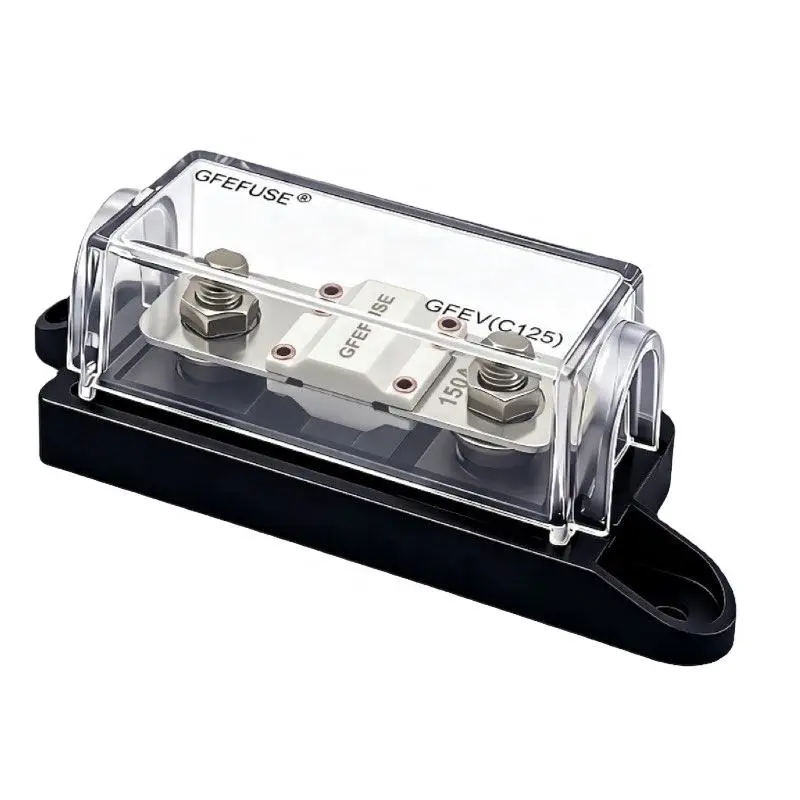
The GFEV(C200C) Inline Mini Car Bolt‑On Fuse Holder is an inline series‑type unit. Specifically, it works for ANL‑C small flat fuses.
It uses UL‑94V‑0 glass‑filled‑nylon housing. In addition, it adopts M5 torque‑defined bolts with a 5 Nm maximum torque. It accepts wire gauge up to 20 mm² and supports max 200A for DC32‑58V circuits.
Real‑World Deployment Cases
‑ RV and camper‑van main battery harness inline safeguard: Installers place GFEV(C200C) directly along battery positive wiring. No cabinet cut‑out is required. Field technicians can swap fuses quickly without full disassembly of power boxes. ‑ Battery‑module internal interconnection harness: Inside battery‑box assemblies, this inline unit delivers series over‑current‑protection. It creates accessible fuse‑swap points without opening large‑size control cabinets. ‑ Automotive primary branch wiring‑harness protection: Harness designers place this holder along main power lines for auxiliary‑equipment loops. The M5 bolt reliably clamps heavy‑gauge automotive copper cables.
Important Practical Limit
Always keep 5 Nm torque for M5 fasteners. Over‑torque will crack nylon housing. Meanwhile, insufficient torque creates high‑resistance hot‑spots under road vibration.
The GFEV(A500A2) One‑In Two‑Out ANL Bolt‑Down Fuse Holder offers unique one‑input two‑output architecture. As a result, one single unit can replace two separate fuse holders.
It uses UL‑94V‑0 glass‑filled PBT base plus transparent PC cover. Furthermore, grade‑8.8 high‑strength screws support 30‑500A under DC12‑125V. It pairs with ANL‑A fork‑bolt fuses for dual‑branch power distribution.
Real‑World Deployment Cases
‑ Recreational‑vehicle battery‑bank multi‑load distribution: RV builders feed one battery input into this holder. It splits power to inverter branch and water‑heater branch with independent fuse protection. ‑ Heavy‑duty commercial‑truck battery‑compartment multi‑auxiliary‑circuit: Inside truck battery boxes, it protects two separate auxiliary‑equipment loops. It reduces total component count for cabinet layouts. ‑ Automotive battery post dual‑accessory protection: One main car‑battery input supplies power for car‑audio and auxiliary‑lighting circuits at the same time.
Important Practical Limit
The sum‑total current from both output branches cannot exceed the 500A maximum rating of this fuse‑holder.
The GFEV(A800AF/AH) ANL Automotive Bolt‑Down Fuse Holder provides two stud variants. You can select M8 version (A800AF) or M10 version (A800AH) according to cable‑lug size.
It uses UL‑94V‑0 PBT‑GF base. Notably, it reaches 1500V DC dielectric withstand and supports DC10‑500A under DC12‑125V. It works across wide ‑40℃ ~ +125℃ temperature range for ANL‑A fork‑bolt fuses.
Real‑World Deployment Cases
‑ Outdoor energy‑storage cabinet battery‑module output protection: Container‑type energy‑storage equipment suffers large temperature swings. This holder tolerates thermal fluctuation for unattended field‑operation. ‑ Industrial forklift battery main‑circuit safeguard: Forklift units produce continuous mechanical vibration in daily shifts. Designers match stud size to cable‑lug dimension for stable bolt‑clamping. ‑ Telecom remote base‑station DC backup‑battery loops: Unattended outdoor telecom sites need hardware that survives hot summer and cold‑winter climate change. ‑ EV‑charging‑pile internal auxiliary low‑voltage DC circuits: High 1500V DC dielectric‑withstand adds safety‑margin near high‑power conversion PCBA inside charging‑cabinets.
Important Practical Limit
Match stud size (M8 / M10) strictly with cable‑lug inner‑hole dimension. Mismatched lug‑stud combination will trigger abnormal local over‑heating.
The GFEV(A500) ANL Automotive Bolt‑On Fuse Holder uses gold‑plated grade‑8.8 carbon‑steel contact hardware. In addition, UL‑94V‑0 PBT‑plus‑PC housing improves mechanical safety.
It supports mixed AC‑DC 12‑250V and DC 30‑500A. It delivers 1500V DC dielectric withstand for ANL‑A fork‑bolt fuses. Gold‑plated contacts resist oxidation under salt‑mist and high‑humidity environments.
Real‑World Deployment Cases
‑ Small‑vessel marine on‑board instrument power‑loops: Boat‑board systems work under salt‑spray humid‑atmosphere. Gold‑plated contacts slow oxidation for long‑term unattended marine‑service cycles. ‑ New‑energy‑vehicle assembly auxiliary‑power‑circuit: 1500V DC dielectric‑withstand creates safety‑margin next to vehicle high‑voltage power‑electronics assemblies. ‑ High‑power car‑audio and RV‑modification projects: Transparent PC top‑cover lets installers inspect fuse health directly without hardware disassembly.
Important Practical Limit
Even with gold‑plated hardware, marine projects still recommend supplementary anti‑corrosion grease on bolt‑lug contact‑surfaces.
The GFEV(A100) ANL Automotive Bolt‑On Fuse Holder adopts full‑PC housing with UL94V‑2 rating. It uses grade‑4.8 fasteners and supports DC32V working condition.
Its current range covers 30‑400A. Notably, the 400A rating only applies for short‑time surge events. It fits ANL‑A fork‑bolt fuses for cost‑sensitive aftermarket‑retrofit scenarios.
Real‑World Deployment Cases
‑ Cost‑focused high‑power car‑audio aftermarket retrofit: Modification shops widely select this holder for car‑amplifier main‑input‑protection inside 32V vehicle‑electrical‑systems. ‑ Light‑duty auxiliary‑vehicle transient‑surge‑protection: Garden‑vehicles and small utility‑vehicles produce high‑ampere current only during motor start‑up. They do not need continuous maximum‑rating loading. ‑ EV auxiliary‑battery secondary‑loop safeguard: Non‑main‑power auxiliary circuits inside electric‑vehicles see 400A only for brief surge‑moments.
Important Practical Limit
Never run continuous 400A load. Apply sufficient current derating for sealed cabinets with poor air‑convection.
The GFEV(A150) ANL Automotive Bolt‑On Fuse Holder upgrades base material to heat‑resistant PA66 plus PC top‑cover. Both materials reach UL94V‑2 flammability grade.
Its electrical‑specifications stay identical to GFEV(A100). It supports DC32V, 30‑400A (400A short‑time‑only) with grade‑4.8 fasteners for ANL‑A fork‑bolt fuses. PA66 base improves thermal‑mechanical‑strength for high‑temperature installation spots.
Real‑World Deployment Cases
‑ Car‑audio modification close‑to‑engine‑bay heat‑sources: It mounts near engine‑compartment heat‑radiation zones. PA66 base handles conducted heat better than pure‑PC housing. ‑ EV auxiliary‑battery circuits adjacent to motor‑controller heat‑sources: Vehicle compartments have components that radiate persistent heat toward fuse‑holder location. ‑ Medium‑duty utility‑vehicles under combined vibration plus moderate heat‑build‑up: PA66 material reduces deformation risk under long‑term road‑vibration and moderate thermal stress.
Important Practical Limit
The 400A rating remains limited to short‑time surge‑events. Continuous‑load still requires mandatory current‑derating, despite upgraded PA66 base material.
General Common Design‑Rules Summarized From Real‑World Cases
Across all seven field‑deployment case‑studies, hardware engineers need to follow universal best‑practices. These rules apply for all bolt‑on fuse‑holder projects.
Confirm fuse‑holder working‑voltage must be higher than maximum system operating‑voltage of target equipment.
Respect component short‑time‑only rating. Do not treat surge‑current parameters as continuous‑working‑current capacity.
Select correct stud / bolt dimension matching cable‑lug hole‑size. Mismatched hardware creates hot‑spot failure risk.
Apply required torque‑values. Both over‑tightening and insufficient tightening produce reliability‑problems under vibration.
Reserve heat‑dissipation clearance. Sealed cabinets always demand extra‑current derating regardless of housing‑material grade.
Select matching genuine series fuses. Mismatched third‑party fuses with inconsistent geometry trigger bad‑contact and thermal‑runaway hazards.
Need Custom Evaluation Samples For Your Project?
Dongguan GongFu Electronics (EssFuse / GFEFUSE) supplies physical evaluation samples. It also supports OEM / ODM custom‑modification and complete datasheet drawing files for B2B system‑integrator customers.
If you want to validate any above‑mentioned fuse‑holder model for your hardware‑design, please reach our sales‑team for quotation and document download.
Go to contact‑us page for technical support & sample request
FAQ for Application‑Oriented Designers
1: How do I choose between GFEV(A100) and GFEV(A150)?
A: Pick GFEV(A150) if fuse‑holder sits near heat‑sources. Choose cost‑optimized GFEV(A100) for normal‑temperature retrofits without significant radiated‑heat exposure.
2: When should I select one‑in‑two‑out GFEV(A500A2)?
A: Use it when you need two independently‑protected output‑branches powered by one shared main‑battery input. This setup reduces hardware‑part‑count and cabinet‑space‑occupation.
3: Why select gold‑plated‑contact GFEV(A500) for marine projects?
A: Gold‑plated contacts slow oxidation under salt‑mist high‑humidity environment. It brings longer service‑life for on‑board vessels.