













مدونة
صمامات تخزين الطاقة في الصين: كيفية الاختيار، وكيفية التركيب، وحلول الحماية الكاملة | GFEFUSE / EssFuse

H2: Introduction
Battery Energy Storage Systems (BESS) built in China are rapidly deployed worldwide. These systems serve utility-scale, commercial & industrial, and residential energy storage applications. The energy storage fuse acts as the core safety component for DC overcurrent protection. Many system integrators face common headaches during project design. These issues include improper fuse selection, poor installation coordination and thermal derating problems. As a result, these mistakes may cause nuisance tripping, thermal runaway risk and costly system failure. This complete guide explains how to select China energy storage fuses and how to apply them inside BESS racks and PCS cabinets. Furthermore, it delivers a full-layer protection solution from battery module, string, rack to PCS DC side. This solution is engineered by GFEFuse under the EssFuse product line.
H2: What Is A Specialized China Energy Storage Fuse?
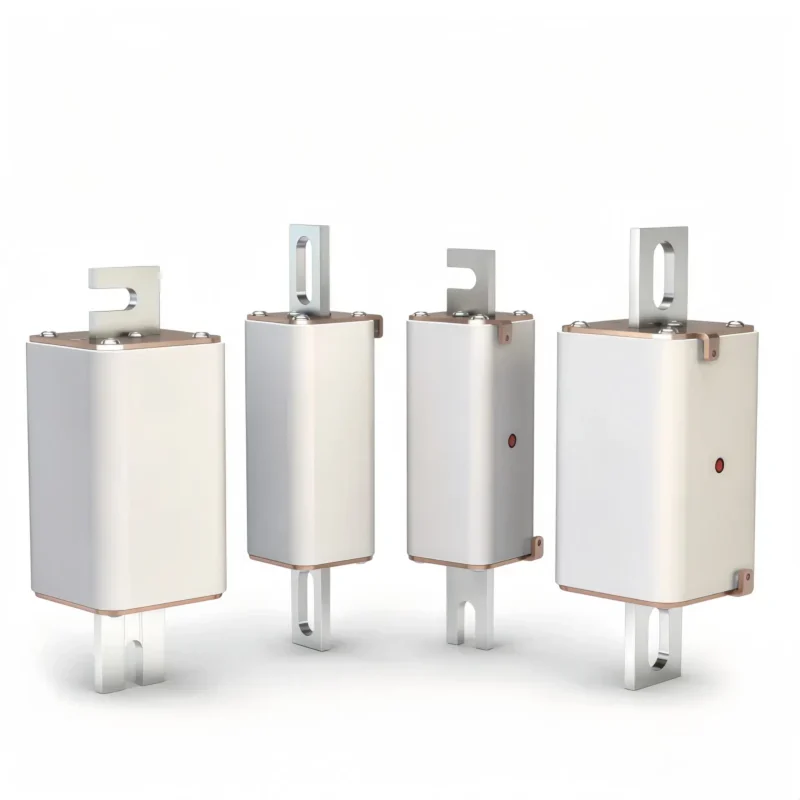
Standard DC fuses cannot meet the strict protection requirements of lithium battery energy storage. Energy storage fuses, class aBat or gPV high-speed DC fuses, are specially designed for Li-ion battery DC circuits. Notably, they have several key advantages. They offer high DC interrupting rating, low minimum breaking current and controlled I²t let-through. They also maintain stable performance under DC fault conditions with high L/R time constant. GFEFUSE EssFuse series energy storage fuses are developed for 1000V and 1500V DC BESS platforms. Moreover, they are widely deployed in Chinese energy storage projects and exported to global ESS integrators.
H2: Step-by-Step Guide: How to Select China Energy Storage Fuse
H3: 1. Confirm DC Voltage Rating
The fuse rated DC voltage must be greater than or equal to the maximum open-circuit voltage of the battery cluster. Engineers need to reserve sufficient safety margin.
- 1000V BESS system: select ≥1000VDC fuse
- 1500V BESS (mainstream China utility storage): select 1500VDC energy storage fuse
Critical note: You cannot downgrade fuse voltage rating. A lower-rated fuse cannot safely extinguish DC arc once a short-circuit fault occurs.
H3: 2. Rated Continuous Current & Thermal Derating
You should not select a fuse only according to the nominal battery current. In fact, multiple factors affect current derating. Ambient cabinet temperature, enclosure airflow, busbar heating and altitude will all reduce usable current capacity.
- Read the max continuous charge and discharge current of your battery string or rack.
- Apply the derating factor. The typical value is 0.7~0.9 for closed storage cabinets.
- Reserve margin for transient charging inrush current. This step helps avoid nuisance tripping during pre-charge.
Rule: Over-sizing weakens short-circuit protection. On the other hand, under-sizing causes unwanted trips under normal working current. GFEFUSE EssFuse datasheets include pre-calculated thermal derating curves for cabinet installation.
H3:3. Interrupting Rating & Minimum Breaking Capacity (MBC)
This parameter is the most critical for China BESS projects. First, the fuse interrupting rating must be higher than the prospective short-circuit current at the installation point. Second, check the minimum breaking current (MBC). The fuse must reliably clear low-level battery fault current before thermal runaway develops. In addition, match the circuit L/R time constant. Battery racks create highly inductive DC loops. Therefore, you need fuses validated under high L/R test conditions. EssFuse (GFEFUSE) energy storage fuses are fully tested under high L/R DC fault conditions for lithium battery systems.
H3:4. Time-Current Curve & Selective Coordination
Multi-layer BESS protection relies on selective coordination. In short, the lower-level fuse on the battery string trips first when local faults happen. Meanwhile, the upper-level rack or PCS-side fuse remains intact. This design prevents full system shutdown. GFEFUSE provides TCC curve data for every EssFuse energy storage fuse model. Engineers can use these curves for system coordination simulation.
H3:5. Mechanical & Holder Matching
Check the fuse body dimension, mounting type, and rated current & voltage of the fuse holder. The contact resistance of the fuse holder directly affects temperature rise during continuous operation. EssFuse are fully compatible with matching GFEFUSE fuse holders for rack assembly.
H3:6. Compliance Certification
China energy storage fuses for export need IEC or UL certifications. These certificates help meet global ESS safety standards.
H2: How To Use Energy Storage Fuse In BESS (Application & Installation Rules)
H3: 1. Installation Position & Layered Protection Layout
Chinese standard BESS adopts three-layer fuse protection architecture:
- Module Level Fuse: Installed inside the battery pack. It protects single cell module faults.
- String / Rack Fuse: Mounted on the battery rack busbar. It isolates the faulty battery string.
- PCS DC Input Fuse: Protects PCS power semiconductors such as IGBT or SiC from DC short circuits.
H3: 2. Application Best Practices
- Install the fuse on the DC positive pole. Coordinate its protection logic with the BMS system.
- Choose proper wire or busbar cross-section to reduce contact resistance and heat accumulation.
- Avoid fitting fuses inside sealed cabinets without thermal airflow design. Also, regularly check temperature rise.
- Do not mix standard DC fuses and GFEFUSE EssFuse aBat fuses in one protection loop.
- Complete pre-tests with real system fault simulation before mass production.
H3: 3. Common Mistakes In Using Energy Storage Fuse
- Using AC fuse for DC energy storage circuits. AC fuses cannot break DC arcs.
- Ignoring temperature derating and selecting a fuse with too small rated current.
- Poor selective coordination: multiple layers of fuses trip together during a fault.
- Neglecting L/R time constant validation. The fuse may fail to clear low fault current.
H2: GFEFUSE EssFuse Complete China Energy Storage Fuse Solution
GFEFUSE EssFuse series is a full portfolio of high-speed DC fuses for energy storage. It delivers complete solutions for 1000V and 1500V BESS platforms.
- Battery Module Fuses: Small-size high-speed EssFuse for internal battery pack protection
- Battery String / Rack Fuses: 1500VDC aBat EssFuse for energy storage cabinets
- PCS DC side semiconductor protection fuses: low I²t design for SiC and IGBT protection
- Supporting GFEFUSE fuse holders and busbar accessories
Our technical services cover TCC curve supply, derating calculation, selective coordination simulation, sample testing and custom development. Our GFEFUSE EssFuse energy storage fuses are validated in mass Chinese energy storage projects. They are exported for global commercial and utility BESS projects.
H2: FAQ
H3: Q1: What is the difference between energy storage fuse and ordinary DC fuse?
A: GFEFUSE EssFuse energy storage fuse (aBat/gPV) is optimized for lithium battery DC faults. It can break low-level fault current and control I²t to stop thermal runaway. In contrast, ordinary DC fuses cannot handle high L/R DC battery faults.
H3: Q2: Can I use 1000V fuse on 1500V BESS system?
A: No. The rated DC voltage must meet or exceed the maximum open-circuit voltage of the battery cluster. An underrated fuse cannot extinguish DC arc and creates cabinet fire risk. Choose the matching EssFuse model from GFEFUSE.
H3: Q3: Where are GFEFUSE EssFuse energy storage fuses manufactured?
A: GFEFUSE EssFuse energy storage fuses are designed and manufactured in China. They are fully tested for the global BESS market with IEC/UL certificates.
H3: Q4: How to achieve selective coordination in multi-rack energy storage system?
A: Select fuses with matched TCC curves for each protection layer. Calculate fault current and coordination time margin. GFEFUSE engineering team can provide a full coordination simulation report for EssFuse series.
H2: Conclusion
China energy storage fuse selection is an engineering decision. You need to evaluate system voltage, continuous current, short-circuit current, L/R time constant and thermal environment. With proper layered protection scheme, you can effectively prevent lithium battery thermal runaway and protect the whole BESS asset. GFEFUSE EssFuse delivers a complete one-stop energy storage fuse solution for global energy storage integrators, PCS and battery pack manufacturers. Contact our engineering team to get fuse recommendation and technical calculation for your BESS project.